ART EMOTION FLOW
Comparison of Raoul Dufy and David Cox: AEF Perspectives, Limitations, and Utility
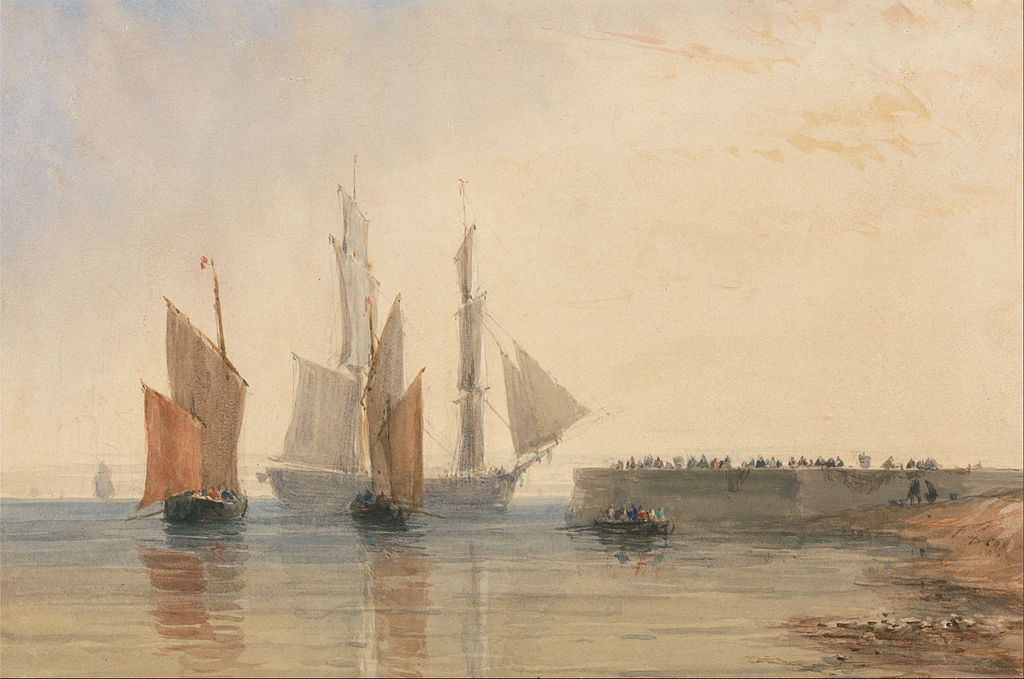
Raoul Dufy vs. David Cox: AEF Comparison
While both artists depict the sea and boats, their work emits different energy frequencies. Raoul Dufy provides 'visual refreshment,' whereas David Cox offers 'static immersion' and 'low-settled tranquility.' When comparing David Cox’s Entrance to Calais Harbour to Raoul Dufy’s yacht paintings (previously discussed in the Balancing Healing ART 9 series), we find that even with the same subject matter—the sea and boats—the energy frequency received by our nervous system is entirely different. While Dufy provides "visual refreshment," Cox offers "static immersion" and "low-settled tranquility." Let’s analyze this through the lens of Art Emotion Flow (AEF). The Artistic Style of David Cox (1783–1859) David Cox was a master of the Golden Age of British watercolor and a precursor to Impressionism. He focused on capturing the Atmosphere and the vivid sense of presence provided by light and weather. He excelled at painting the "texture of the air," using washes and layering to depict shifting clouds and misty harbors. He famously used Scotch Wrapping Paper—a rough, tinted paper that created a unique granulation effect, emphasizing the materiality and weight of the landscape. His focus on how light changes objects momentarily, rather than fixed forms, deeply influenced Turner and later French Impressionists.
| Category | Raoul Dufy | David Cox |
|---|---|---|
| Flow Type | Exhale Flow (Radiant) | Inhale Flow (Convergent) |
| Saturation | High (Vivid Blues) | Low (Muted Grays/Browns) |
| Material | Transparent/Smooth | Rough/Granulated Paper |
| Response | Dopamine / Beta waves | Serotonin / Alpha waves |
1. Material Density and Resistance
Dufy’s lines are like "sliding on ice" without friction. In contrast, Cox’s brushstrokes carry the weight of moisture and wind resistance, causing the viewer’s energy to converge inward, creating a sense of 'Emotional Grounding.'
2. AEF DSL Logic Examples
// David Cox: Inhale Flow
ArtWork "Entrance to Calais Harbour" {
    Material: Rough_Paper(granulation: high);
    NervousSystem_Response {
        Arousal: Decrease;
        Neurotransmitter: Serotonin;
        Mechanism: Inhale_Flow;
    }
}

// Raoul Dufy: Exhale Flow
ArtWork "Regatta at Cowes" {
    Material: Smooth_Canvas(transparency: high);
    NervousSystem_Response {
        Arousal: Increase;
        Neurotransmitter: Dopamine;
        Mechanism: Exhale_Flow;
    }
}
3. Utility and Limitations of AEF
- Limitations: AEF is a "momentary snapshot" and may not fully capture the artist's complex philosophical intent or subjective cultural variations. Emotional responses change in real-time based on the viewer's condition. AEF cannot capture every variable context.Reducing a painter's philosophical message to mere "nervous system relaxation" risks oversimplifying the humanistic value of art.
- Utility: It serves as a practical 'Emotional Vitamin' or a technical interface for AI-driven digital wellness and environmental design. It validates the "coolness" or "comfort" felt by the body through scientific logic before one even reads a critique.It positions art as an "emotional vitamin" to regulate stress rather than an object of difficult study.
"AEF is not a final answer, but a sophisticated interface to safely connect with the energy of art." AEF is not a "final answer" that defines the essence of art; it is a sophisticated interface and a personal tool that helps us safely connect to the unfamiliar world of art and borrow its energy. <1>A Tuner: To adjust the frequency of our emotions (Dopamine vs. Serotonin). <2>A Trigger: To summon cultural memories and nostalgia (e.g., Victorian Era). <3>A Protocol: A pre-verbal dialogue that tells our nervous system, "It’s time to inhale (converge)" or "It’s time to exhale (radiate)." -----While AEF does not replace psychological or academic criticism, it serves as a complementary practical tool for digital wellness systems, environmental design, and guiding novice viewers through "sensory synchronization."