ART EMOTION FLOW
Georges Seurat: The Mathematical Architecture of Light and Shadow
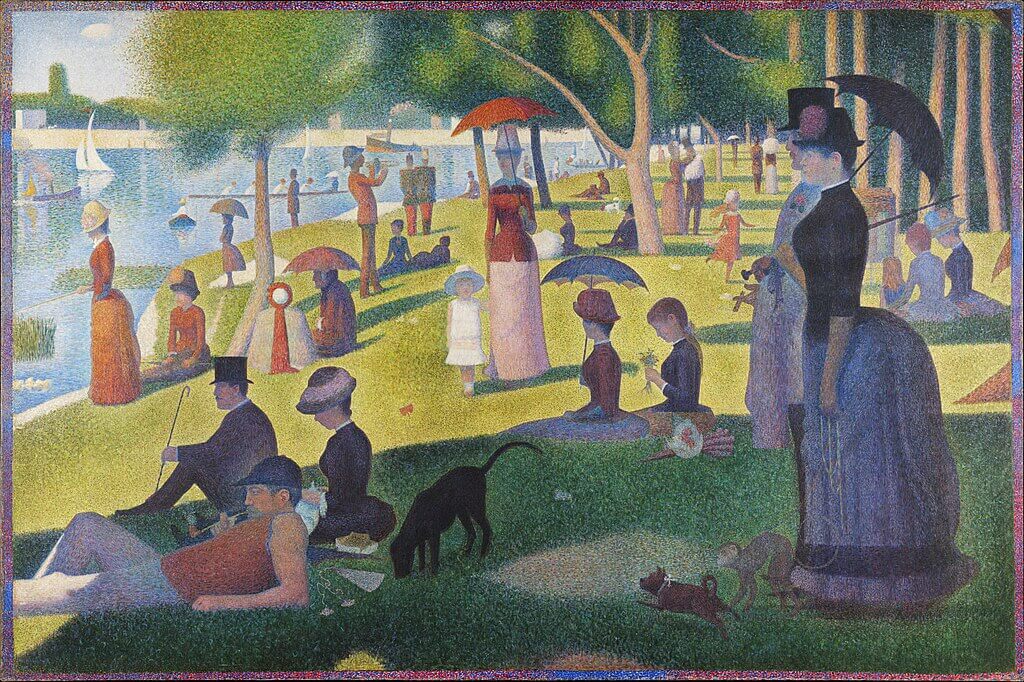
Georges Seurat: The Mathematical Architecture of Light and Shadow
Case Study #06: Achieving Equilibrium through Pointillism
1. Visual Resonance: Thermal Contrast and Geometric Stability
In "A Sunday on La Grande Jatte," Seurat employs a rigorous contrast between the warm amber of the sun-drenched grass and the cool, deep emerald of the shade. While traditional Impressionism might feel fleeting, Seurat’s dots provide a "visual anchor." This thermal contrast creates a rhythmic oscillation for the eye, guiding the observer into a state of structural stability. From a conventional art-historical perspective, this is described as Seurat’s scientific approach to color theory and his Neo-Impressionist innovation. From an AEF perspective, however, the same contrast is understood as a neurological stabilizer, balancing sensory input and reducing cognitive fatigue.
2. Sensory Transfer Flow: The 'Visual White Noise'
The millions of dots act as a form of "Visual White Noise." To the nervous system, these repetitive, precise points function like a constant frequency that masks modern mental static. As the eye blends these dots, the brain transitions from a state of cognitive scattering to one of synchronous resonance, mimicking the calming effect of fine sand falling or a soft, distant hum. Traditional analysis would emphasize Seurat’s meticulous technique and his devotion to optical science. AEF analysis reframes this as a therapeutic rhythm: the dots are not only pigment but pulses of calm, transforming visual complexity into emotional equilibrium.
3. Emotional Balancing: Order within the Infinite
The final output of this AEF process is Deep Homeostasis. The figures in the painting are frozen in time, creating a "Safe Zone" where no chaotic change can occur. By processing the orderly light of Seurat, the observer’s heart rate stabilizes, and the autonomic nervous system reaches a state of 'Dynamic Rest.' Conventional art history would describe this as Seurat’s attempt to impose discipline on Impressionism. AEF analysis interprets it as a direct emotional intervention: order becomes comfort, geometry becomes therapy.
"Seurat proves that order is the most refined form of comfort. Through his dots, we find that the chaos of light can be tamed into a sanctuary of peace."
4. Conventional vs. AEF Analysis: Why the Difference Matters
Conventional art-historical analysis situates Seurat within Neo-Impressionism, emphasizing his scientific rigor, his influence on later modernists, and his role in advancing color theory. It explains what Seurat did and why it mattered in the trajectory of art history. Emotional transfer analysis (AEF), however, asks a different question: What does Seurat’s work do to us now? It highlights the physiological and psychological effects of his dots, the way visual rhythm becomes emotional therapy, and how order translates into comfort. This difference is not trivial—it expands the value of art from historical knowledge to present-day healing.
| Aspect | Conventional Analysis | AEF Emotional Transfer |
|---|---|---|
| Focus | Technique, color theory, historical context | Physiological and emotional impact |
| Value Source | Innovation, influence, cultural meaning | Aura of rhythm, therapeutic order |
| Viewer Role | Interpreter of meaning | Participant in emotional flow |
| Outcome | Knowledge acquisition | Emotional recovery, homeostasis |
5. Why AEF is Needed Today
In the age of information overload and AI-driven content, conventional art analysis often remains confined to historical or stylistic explanation. While valuable, it does not address the urgent need for emotional regulation and psychological recovery in modern life. AEF analysis fills this gap by reframing art as a tool for healing. Seurat’s dots are not only innovations in color theory but also micro-pulses of calm. His frozen figures are not only compositional choices