ART EMOTION FLOW
Raoul Dufy’s Yachts: The Neuroscientific Reasons Behind Visual Refreshment
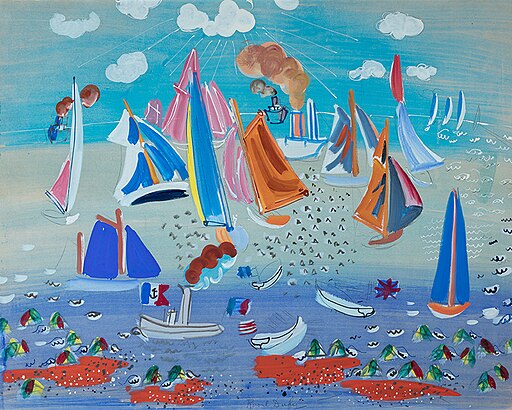
Raoul Dufy’s Yachts:
Art-Historical Value and Emotional Resonance
Raoul Dufy (1877–1953) was a French Fauvist and later decorative modernist painter. His art-historical value lies in his liberation of color from form, his joyful depictions of leisure, and his influence on textile and mural design. Yet beyond history, his works also function as emotional regulators, shaping how viewers feel through color, rhythm, and aura.
Dufy’s paintings are celebrated for their vibrant palette and lighthearted subjects—regattas, orchestras, and seaside promenades. He separated color from contour, allowing hues to float freely across the canvas. This innovation aligned him with Fauvism but also anticipated later modernist design. His contribution was not only stylistic but cultural: he embodied the optimism of early 20th-century leisure society.
His decorative murals, such as La Fée Électricité, demonstrated how modern art could merge with public space, turning color into civic energy. Thus, his art-historical significance rests on both innovation and accessibility.
Dufy’s technique involved swift, calligraphic lines paired with washes of pure color. He often allowed outlines to remain independent from the color fields, creating a playful disjunction that emphasized freedom. His brushwork conveyed rhythm, echoing music and movement. This method was not about mimetic accuracy but about capturing the sensation of life.
By using ultramarine, cyan, and radiant reds, he created chromatic environments that stimulated both visual and emotional systems. His art was a celebration of perception itself.
Unlike traditional art-historical analysis, emotional transfer analysis (AEF) asks: What does the painting do to the viewer’s nervous system? Dufy’s liberated colors reduce cognitive load, producing visual liberation. Cool blues induce psychological cooling, lowering perceived body temperature and stress. Dynamic lines activate mirror neurons, synchronizing the viewer’s body with the rhythm of wind and waves.
The buoyancy of his compositions stimulates dopamine release, counteracting daily gravity. In this sense, Dufy’s art is not only decorative but therapeutic—a visual mechanism for emotional recovery.
Conventional analysis emphasizes Dufy’s Fauvist heritage, his role in decorative modernism, and his stylistic innovations. Emotional transfer analysis emphasizes how his art feels: the cooling effect of blue, the kinetic resonance of line, the buoyancy of composition. The difference is clear: one explains historical meaning, the other measures emotional impact.
| Aspect | Conventional Analysis | Emotional Transfer (AEF) |
|---|---|---|
| Focus | Style, history, influence | Physiological and emotional response |
| Value Source | Innovation, cultural context | Aura of color, kinetic energy |
| Viewer Role | Interpreter of meaning | Participant in emotional flow |
| Outcome | Knowledge acquisition | Emotional refreshment |