ART EMOTION FLOW
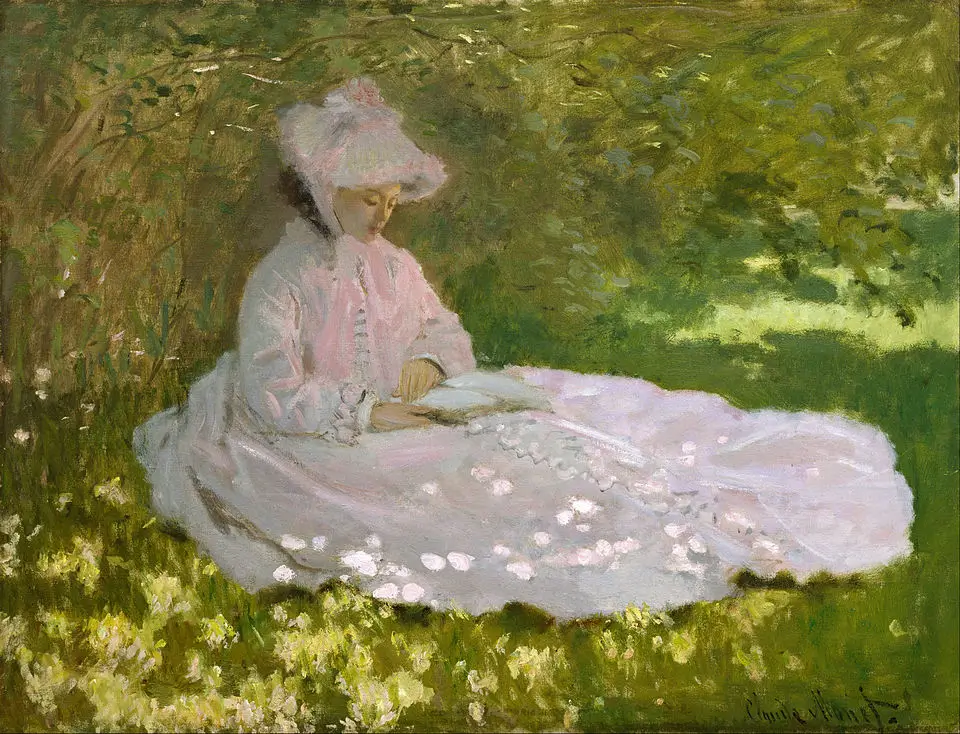
Claude Monet: Spring (Springtime) – The Architecture of Tranquil Focus
Claude Monet: Spring (Springtime) – The Architecture of Tranquil Focus
"Emotional Diagnosis: Cultivating Inner Peace through Stillness and Warmth"
1. Capturing the Fleeting Warmth of Argenteuil
Oscar-Claude Monet (1840–1926), the foundational figure of French Impressionism, dedicated his life to capturing the ephemeral nature of light. "Spring" (Printemps), also known as The Reader (La Liseuse), painted in 1872, is a profound expression of his domestic harmony.
The painting features his first wife, Camille Doncieux, seated beneath a lush canopy of lilacs. Unlike his broader landscapes, this work focuses intimately on Camille’s form, capturing a rare moment of profound quietude during their time in Argenteuil. It is currently preserved at the Walters Art Museum in Baltimore.
2. Psychological Diagnosis: The Serenity of the 'Reading Pose'
According to the James-Lange Theory, our physiological state dictates our emotional experience. Camille’s pose—shoulders relaxed, head tilted, body settled—acts as a non-verbal cue for "Parasympathetic Activation."
As the viewer observes Camille's focus on her book, their own mirror neurons facilitate a "sympathetic stillness." The visual stimulus of sunlight filtering through leaves (Komorebi) creates a rhythmic pattern of light and shadow on her muslin dress, which naturally induces a meditative state, lowering the viewer's mental "noise" and fostering internal warmth.
3.1. Muslin and Sunlight: Tactile Comfort
Monet masterfully depicts sunlight piercing through the lilac canopy, creating vibrant streaks of gold on the white fabric.
- Embodied Warmth: The visual contrast between the cool shade of the canopy and the warm streaks of sun on the dress triggers an "Embodied Cognition" of a perfect spring day.
- Soft Focus: The intimacy of the composition centers the viewer’s attention, providing a "visual sanctuary" away from the chaotic distractions of modern digital life.
3.2. Environmental Security
The lilac canopy acts as a natural architecture—a shield that creates a private, safe space. Psychologically, being "under cover" while exposed to light provides a sense of Refuge and Prospect. This duality allows the viewer to feel protected yet free, an essential combination for deep psychological rest.